
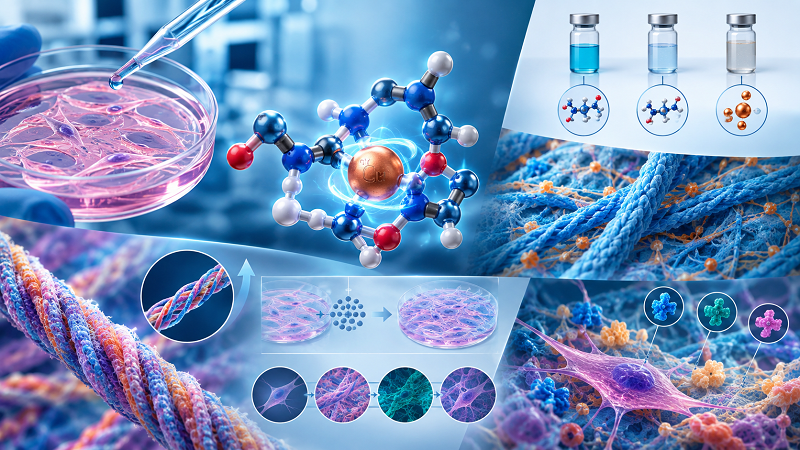
GHK-Cu is a small copper-peptide complex that has attracted interest in research on cells and the extracellular matrix, the material that surrounds and supports them. It is often introduced as a copper peptide, but its research background is more detailed than that short description suggests.
Scientists have investigated GHK-Cu in fibroblast cultures to explore collagen production, matrix-related molecules and markers linked with remodelling. Together, these studies help explain why the compound continues to appear in discussions about cellular research.
What makes GHK-Cu different
GHK is a small peptide consisting of three amino acids: glycine, histidine, and lysine. When combined with copper, it forms the compound known as GHK-Cu. The copper is part of the compound’s identity, which is why researchers may compare GHK-Cu with GHK alone and copper ions alone.
These comparisons can reveal whether related materials behave differently in a particular test. It is an example of the careful approach researchers take when investigating a small molecule: define the material clearly, choose a focused measurement, and compare the results.
GHK-Cu and collagen research
Collagen is a key structural protein that provides strength and support to connective tissues. Fibroblasts produce collagen and other materials that make up the environment around cells, making them a useful model for laboratory research.
A 1988 fibroblast study reported increased collagen synthesis in GHK-Cu-treated cultures under the conditions tested. The researchers also assessed cell numbers, allowing them to separate a change in collagen production from a simple increase in the number of cells. Findings like this helped establish collagen as one of the areas most often associated with GHK-Cu research.
Looking beyond collagen
The extracellular matrix contains more than collagen. It includes many molecules that help create the organised environment around cells. A 1992 study investigated GHK-Cu and several matrix-associated molecules in cultured human fibroblasts. Some of the measurements changed, while others did not.
That detail is important. It shows that research can be more useful when it asks specific questions rather than treating every part of the cellular environment as if it responds in the same way.
Matrix remodelling and future questions
Scientists also study how cells organise and alter the material around them over time, a process often called remodelling. A 2000 study compared GHK-Cu, GHK alone and copper ions while measuring selected remodelling markers. The work adds another dimension to the research by examining how closely related materials can produce different observations in the same type of experiment.
GHK-Cu remains an interesting subject because it sits at the intersection of peptide chemistry, copper biology, and the detailed world of cell-matrix research. Further studies may continue to clarify how these pieces fit together.
Professionals interested in exploring available GHK-Cu research peptide material can visit Pillar Research for product information and batch documentation.