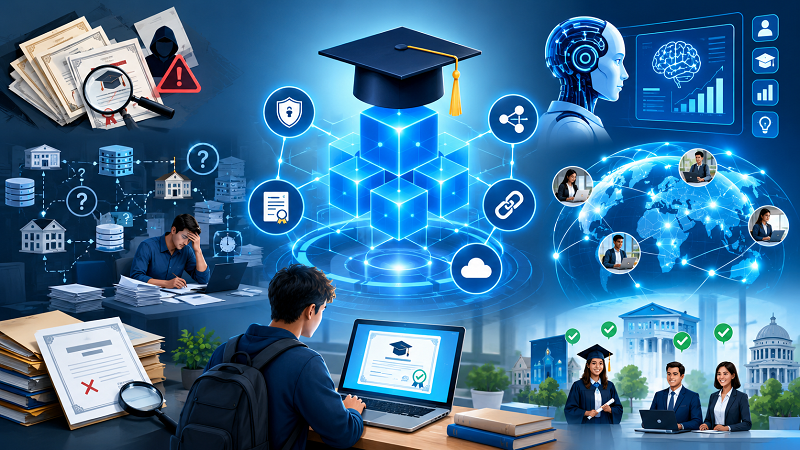
Education systems around the world are moving rapidly toward digital models. Institutions increasingly need secure ways to manage student information, verify academic qualifications, connect records between organizations, and support growing volumes of digital data. Yet even as education becomes more technology-driven, several fundamental problems remain, particularly fragmented student data, fraudulent qualifications, slow verification processes, and limited trust between institutions.
In many education systems, confirming whether a diploma, certificate, or other qualification is legitimate is still a manual process. Universities, employers, licensing organizations, and government agencies may need to contact institutions individually, search separate databases, or request supporting documents before confirming someone’s credentials.
Student records are also frequently stored in independent databases that do not communicate effectively with one another. This creates difficulties when learners move between universities, countries, professional certification programs, or employers.
Blockchain technology in education presents one possible way to address these problems. Because blockchain can maintain decentralized and tamper-resistant records, it can provide an infrastructure for storing, sharing, and verifying academic information without relying entirely on separate institutional databases.
When blockchain is combined with artificial intelligence, the possibilities extend beyond record verification. Trusted educational data can potentially support automated processes, predictive analytics, personalized learning, and more intelligent education platforms.
The growing interest in these technologies reflects a broader effort to make education systems more secure, transparent, connected, and efficient.
Blockchain in Education: Why Traditional Systems Are Becoming Harder to Scale
As the amount of student information continues to grow and education becomes increasingly international, traditional education infrastructure is facing greater pressure.
Universities, schools, examination bodies, employers, professional associations, and government agencies often use separate information systems. When these platforms cannot communicate easily, exchanging academic information becomes slow and complicated.
The globalization of education adds another layer of complexity. Students may study in one country, continue their education in another, and eventually apply for employment somewhere else entirely. Employers and institutions therefore need reliable ways to confirm qualifications issued by organizations they may have little direct relationship with.
Fraudulent or altered credentials create an additional challenge. A report by World Education Services highlights that Fake diplomas, falsified transcripts, and qualifications from questionable institutions can make employers and admissions teams more cautious, increasing the amount of verification required.
At the same time, education systems are producing more digital records than ever before. According to UNESCO, As institutions continue moving toward electronic certificates and digital student records, secure infrastructure for managing those records becomes increasingly important.
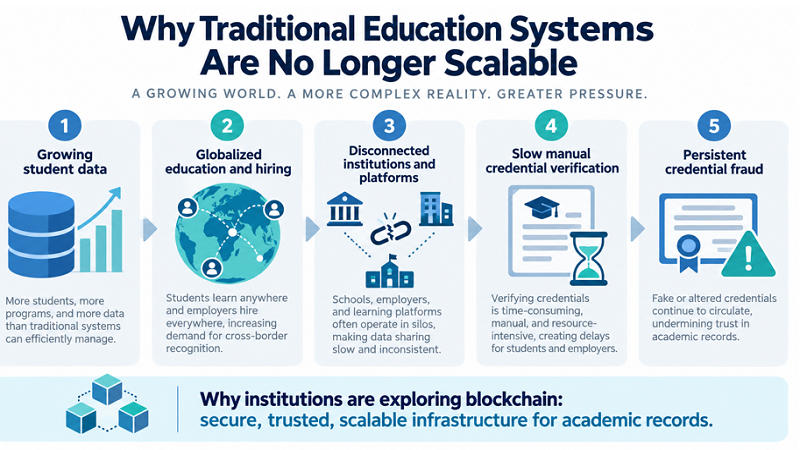
These pressures explain why blockchain is increasingly being explored as a possible long-term infrastructure for academic records and credential management.
Blockchain in Education: Key Challenges in Traditional Systems
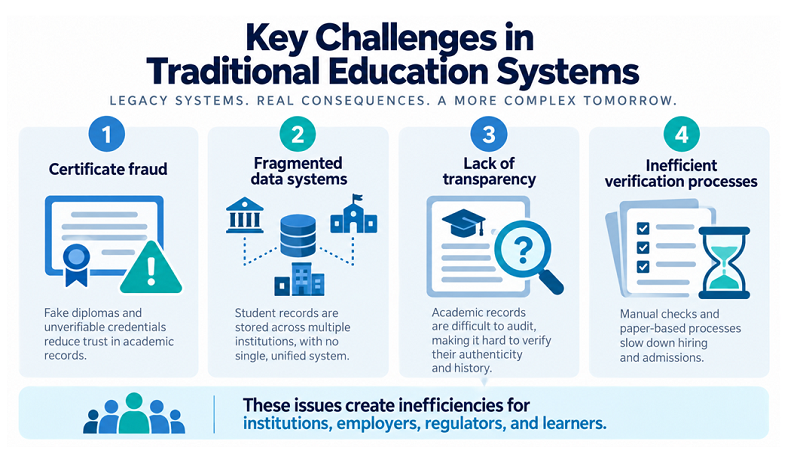
Even after years of digital transformation, several persistent weaknesses remain within traditional education information systems.
The main challenges include:
- Certificate fraud: Fake, altered, or unverifiable diplomas can weaken confidence in academic qualifications.
- Fragmented data systems: Student information is frequently spread across different schools, universities, certification bodies, and databases.
- Lack of transparency: Academic records can be difficult to audit, making it harder to determine whether information has been changed or whether a qualification is authentic.
- Inefficient verification processes: Manual checks can delay university admissions, professional licensing, recruitment, and other processes that depend on academic credentials.
These problems affect more than schools and universities. Employers, government agencies, regulators, professional organizations, and learners can all experience additional costs and delays when reliable education records are difficult to access.
Blockchain in Education: How the Technology Can Address These Challenges
Blockchain creates a distributed and tamper-resistant record system that can change how academic information is stored, verified, and shared.
Instead of relying entirely on isolated databases, authorized education providers can record credentials in a system where changes are traceable and records can be independently verified.
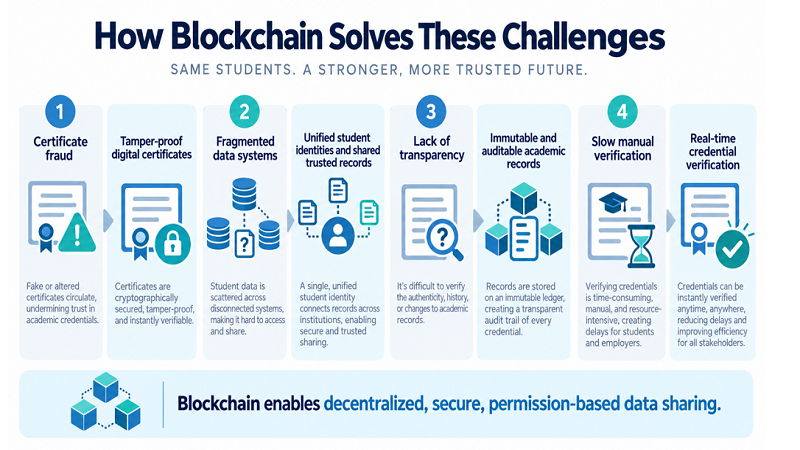
With blockchain-based education systems, institutions can potentially:
- Issue tamper-resistant digital certificates
- Provide near-instant credential verification
- Establish unified or portable student identities
- Support secure, permission-controlled data sharing
- Maintain transparent records of credential issuance
- Reduce dependence on repeated manual verification
- Give learners more control over how their qualifications are shared
Consider the problem of certificate fraud. In a conventional system, an employer may receive a PDF or printed certificate and then need to contact the institution to determine whether it is genuine. With a properly designed blockchain credential system, the credential could instead contain information that allows its authenticity to be checked against an immutable record.
The same principle applies to fragmented student records. Instead of repeatedly requesting documents from multiple institutions, learners could maintain verified digital credentials that authorized organizations can confirm when necessary.
Blockchain therefore does not simply digitize existing processes. Its main value comes from changing how trust is established between organizations that may not share the same database or administrative structure.
Blockchain in Education: Real-World Applications Across Countries
Blockchain has already been explored in education systems in different parts of the world. The scale and purpose of these initiatives vary, but they illustrate how the technology can be applied to practical education challenges.
Malta: Early Adoption of Blockchain-Based Credentials
Malta became an early adopter of blockchain-based academic credentialing by experimenting with digital certificates that could be independently verified.
The approach was designed to provide students with credentials that were more difficult to alter and easier for employers or other institutions to authenticate.
Blockchain-based certificates can provide:
- Faster confirmation of academic qualifications
- Less administrative work for institutions
- Improved confidence in digital credentials
- Greater portability for learners who need to share qualifications internationally
The broader significance of these experiments is that they demonstrated how blockchain credentials could move beyond small technical trials and become part of real education systems.
Vietnam: A National Blockchain System for Academic Records
Vietnam has also explored blockchain at a much larger scale through the development of infrastructure for academic qualifications.
A national qualifications archive model can allow diplomas and education records to be stored in a common digital environment and verified by authorized parties.
Example structure of a national blockchain-based academic record system
In a national model:
- Educational authorities can oversee standards and governance.
- Schools and universities can issue verified academic records.
- Students can hold and share digital credentials.
- Employers and other authorized organizations can verify qualifications.
- Records can remain available even when students move between institutions or geographic regions.
The most significant lesson from national-scale projects is that blockchain-based academic records do not necessarily have to remain limited to individual universities. With appropriate governance and architecture, the technology can support much larger education ecosystems.
South Korea: Developing Blockchain Skills and Infrastructure
South Korea has invested in blockchain-related development as part of broader efforts to prepare its workforce for emerging technologies.
Education plays an important role in this strategy because long-term adoption depends not only on developing blockchain applications but also on training people who understand how to build, manage, regulate, and use them.
Initiatives of this kind can focus on:
- Developing blockchain skills among students and professionals
- Introducing blockchain concepts into technical education
- Experimenting with blockchain within public systems
- Supporting research and development
- Preparing workers for emerging technology-related occupations
This illustrates another dimension of blockchain in education: education systems are not only potential users of blockchain but also responsible for preparing future professionals to work with the technology.
Brazil: Addressing Diploma Fraud
Brazil has also explored digital credential systems as a possible response to fraudulent university qualifications.
Blockchain-based diplomas can make it easier to determine whether a qualification was actually issued by an authorized institution and whether the information has been altered.
A blockchain credential platform can potentially:
- Issue digitally verifiable diplomas
- Confirm credential authenticity
- Create transparent issuance records
- Reduce opportunities for document alteration
- Simplify verification between institutions and employers
The use case demonstrates why credential verification has become one of the most practical and frequently discussed applications of blockchain in education.
Blockchain in Education + AI: Moving From Verification to Intelligence
Blockchain and artificial intelligence address different problems.
According to McKinsey & Company, blockchain is primarily useful for creating trusted, traceable, and tamper-resistant data records. AI, by comparison, is particularly powerful when analyzing information, identifying patterns, automating decisions, and generating predictions.
When the two technologies are combined, trusted education records can become the foundation for more intelligent digital systems.
Blockchain + AI Capability Comparison
| Capability | Blockchain | AI | Combined |
| Data security | High | Medium | High |
| Data analysis | Low | High | High |
| Automation | Medium | High | Very High |
| Trust & transparency | High | Low | High |
The combination can support several education applications:
- Automated credential verification
- Predictive analysis of student performance
- Personalized learning pathways
- Detection of suspicious credential activity
- Automated administrative processes
- Identification of students who may require additional support
- More intelligent institutional decision-making
For example, blockchain could provide a trustworthy history of completed qualifications while AI analyzes learning patterns and recommends future educational opportunities.
Similarly, AI systems could identify unusual credential activity while blockchain records provide the trustworthy historical information needed to investigate it.
Together, the technologies can move education systems from basic digital record keeping toward intelligent education platforms built on trusted data.
Blockchain in Education: Challenges in Enterprise Implementation
Despite its potential, blockchain is not automatically suitable for every education problem.
Based on the analysis provided by the managing director of Achievable, moving from a pilot project to a large institutional or national system creates several challenges.
Important challenges include:
Legacy system integration
Many universities and education authorities already use student information systems, learning management systems, examination platforms, financial software, and other databases.
Replacing all of this infrastructure is rarely practical.
Blockchain solutions therefore often need to integrate with existing systems, which can require complicated technical work, data migration, and customized interfaces.
Regulatory compliance
Education records frequently contain sensitive personal information.
Organizations therefore need to consider privacy requirements, data retention rules, consent, ownership, access permissions, and other legal obligations.
Blockchain’s permanent record structure can also create difficult questions when regulations require information to be corrected or removed.
Scalability
An education system may eventually need to support millions of students and very large numbers of transactions.
The underlying architecture must therefore be capable of expanding without creating unacceptable costs, performance problems, or reliability issues.
Strategic alignment
Not every process benefits from blockchain.
Organizations need to identify situations where decentralized verification or tamper-resistant records provide enough value to justify the additional complexity.
Implementing blockchain simply because the technology is available is unlikely to produce meaningful results.
A successful project should solve a clearly defined educational or administrative problem.
Blockchain in Education: Enterprise Implementation Framework
Organizations considering blockchain should follow a structured implementation process rather than moving immediately into large-scale deployment.
A practical implementation framework may include:
- Identify high-impact use cases: Begin with clearly defined problems where trusted records and verification can provide measurable value.
- Select an appropriate blockchain platform: Consider security, interoperability, performance, governance, ecosystem support, and technical requirements.
- Design scalable system architecture: Build an architecture capable of supporting larger numbers of institutions, learners, and transactions over time.
- Integrate with existing education infrastructure: Connect blockchain with student information systems, learning platforms, identity systems, and existing databases.
- Ensure compliance and long-term scalability: Establish policies for privacy, governance, monitoring, maintenance, and future expansion.
A clear implementation roadmap helps organizations move carefully from experimental projects toward reliable production systems.
Building an Effective Blockchain Education Ecosystem
Successful adoption requires more than selecting blockchain software.
Education systems need to consider how students, universities, regulators, employers, certification organizations, and technology platforms will interact.
Important capabilities may include:
- Secure credential issuance
- Decentralized or portable student records
- Identity management
- Permission-controlled data sharing
- Academic record verification
- Integration with existing learning platforms
- Automated analytics
- AI-assisted administrative systems
- National or international interoperability
The goal should not be to put every piece of education data on a blockchain.
Instead, blockchain should be used selectively in areas where trust, verification, transparency, and portability are particularly important.
Sensitive information can remain inside appropriate institutional systems while blockchain records provide proof that an authorized institution issued a particular qualification or record.
This approach can provide many of the benefits of decentralized verification without unnecessarily exposing personal student information.
Conclusion
As education systems become increasingly digital and internationally connected, the need for trustworthy, transparent, and efficient academic record management will continue to grow.
Blockchain in education provides one possible foundation for securely managing credentials, confirming qualifications, improving data portability, and reducing dependence on slow manual verification processes.
Artificial intelligence can expand these capabilities by analyzing trusted information, automating administrative tasks, identifying patterns, and supporting personalized learning.
However, successful blockchain adoption requires much more than introducing new technology. Institutions must develop appropriate governance, privacy policies, technical architecture, interoperability standards, and long-term implementation strategies.
Blockchain should therefore not be viewed as a universal replacement for existing education technology. Its strongest role is likely to be in areas where multiple organizations need to trust the same information without depending entirely on a single centralized database.
When applied carefully, blockchain can help education systems move from fragmented records and manual verification toward portable credentials, trusted academic data, faster verification, and more connected digital education ecosystems.