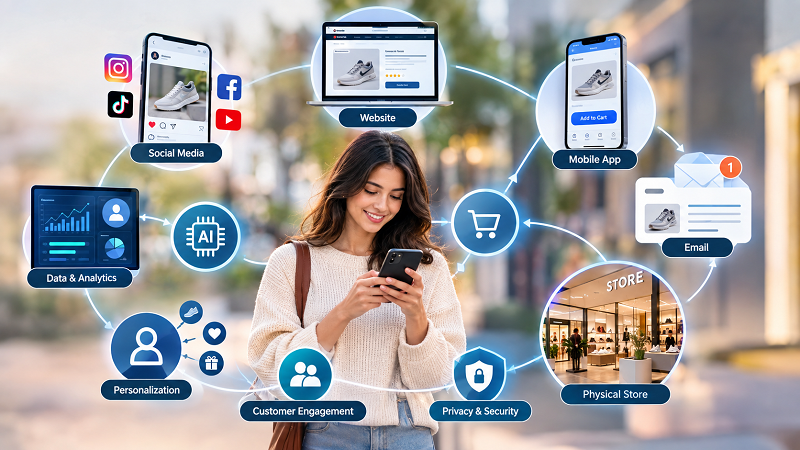
In the present-day digital world, it is crucial for companies to implement successful ways to communicate with their customers via various platforms. Omnichannel marketing provides organisations with an opportunity to develop smooth customer journeys via the integration of websites, social media, emails, mobile apps and retail stores. Thus, customers are provided with an opportunity to interact with the brands they like using various channels of communication without any breaks.
With the ongoing changes in the customers’ requirements, companies should pay attention to consistent communication and the development of individual experiences. Connecting various marketing channels will help companies enhance customer engagement and build relationships.
Why Omnichannel Marketing Is Important for Modern Businesses
Contemporary shoppers usually alternate between the use of digital and traditional channels while researching products or making decisions. For instance, a person may get familiar with a particular product through social media channels, research price comparisons through the website and finally purchase the item in a physical shop. Such an integrated approach will facilitate consistency during the customer journey.
Integration of marketing strategies is important in identifying customer needs and understanding buying patterns. Integration of information from various channels will enable the marketer to have an understanding of customer needs and develop more targeted campaigns.
How Omnichannel Marketing Creates Consistent Customer Experiences
It is important for businesses to be consistent in engaging with their customers. Customers will want to get the same correct information, branding and messaging regardless of the channel they use. Omnichannel marketing helps in providing such consistency, making sure that the customer gets the same brand experience when interacting with the business through any channel.
For instance, customers who add a certain product to their shopping cart on the web will receive personalized reminders through email. Should the customer visit the retail store, the salespersons there will be able to give him relevant information about the product.
The Role of Data in Omnichannel Marketing
Customer data can be highly useful for coming up with a good marketing strategy. Marketers are able to gain a lot of valuable insights through analysis of customers’ visits to websites, their engagement on social media and via email and purchase behavior. Such information provides a clear understanding of customer preferences, patterns and how to engage with them through communications channels.
Omnichannel marketing enables organizations to pull information from various sources and use it to get better insights about their customers. CRM and customer data platforms can assist with this task. Nevertheless, it is essential to respect customers’ privacy when collecting and processing data about them.
Personalisation Through Omnichannel Marketing
Personalization enables companies to come up with marketing messages that correspond with individual consumer tastes and preferences. It may be difficult for generic messages to stand out in competitive digital markets; however, recommendations and communications tailored to consumers’ needs can enable them to establish better connections. Examples of personalization include product recommendations, personalized emails, offers, and web pages.
With the help of omnichannel marketing, companies will be able to sustain consistent personalization across communication channels. For example, customers who often browse products from one category may receive recommendations in email or apps. Personalization should stay relevant and transparent to enable consumers to retain control over their communications.
Using Artificial Intelligence in Omnichannel Marketing
Use of artificial intelligence has transformed the way firms carry out their interactions with customers and their marketing operations. The use of AI-based technologies would enable an organization to analyze large sets of customer data, detect patterns and enable better campaign management. Chat bots, recommendation systems and predictive analytics could be used by organizations to answer customer queries and provide appropriate information through different channels.
The use of AI in omnichannel marketing could also assist businesses in automating certain activities and gaining an understanding of customer behavior. For instance, automated systems can provide suggestions regarding appropriate communication timing depending on past engagement. Nonetheless, human supervision would be necessary for ensuring accuracy, security and meeting the customer expectations.
Measuring the Performance of Omnichannel Marketing
Evaluating the effectiveness of a marketing campaign allows companies to determine the level at which they are succeeding with their efforts. Some of the key metrics that should be used by marketers are conversion rate, retention rate, web traffic, engagement rate and lifetime customer value. These metrics allow the marketer to evaluate different points of the buyer’s journey.
For businesses to adopt an omnichannel marketing approach, it is imperative for them to evaluate performance through connected platforms rather than looking at each individual platform separately. Using attribution models, analytics dashboard and CRM reporting allows marketers to determine what kind of contribution different actions have towards conversions. Performance reviews provide opportunities for companies to fine-tune their marketing campaigns.
Common Challenges of Omnichannel Marketing
Although there are many advantages, using an integrated marketing approach also faces several challenges. Some businesses can have technology problems, have inaccurate information about customers and have difficulty managing resources as well as coordinating departments. All these can lead to fragmented communication and making it more difficult for them to offer a consistent experience for their customers.
The other challenge is related to ensuring accuracy of data and protection of information. For businesses to overcome this challenge, they must have appropriate systems in place and processes within the organisation and employees know what their roles are. In order to overcome such challenges, proper planning and collaboration are required.
How Businesses Can Improve Omnichannel Marketing
Enhancing the Integrated Marketing Strategy is Initiated through the Understanding of the Customer Journey
It is important for businesses to recognize how the customers interact with various platforms and whether there are any possible gaps within the communication process. Through creating customer journey maps, businesses will be able to understand the areas where there may be a need to improve the transitions from digital to physical.
It is essential that businesses invest in appropriate technology and promote cooperation within the departments of marketing, sales and customer service. Omnichannel marketing can be more easily achieved when the departments have access to all necessary information and communicate in accordance with certain rules.
The Future of Omnichannel Marketing
The evolution of integrated marketing in the future will depend on technological advances and shifting customer needs. Artificial intelligence, automation, predictive analytics and sophisticated customer data solutions create new possibilities for firms to better comprehend their audience and communicate with them effectively. Technologies may help achieve timely communication while allowing firms to deal with complicated customer journeys.
With the increased convergence between digital and physical experience, it is crucial for companies to have adaptive marketing frameworks which are able to work with new channels. Omnichannel marketing will still imply the balance between technological advantages and human interaction. Firms that focus on customer needs, responsible data management and effective communication will be well-prepared for changes in the digital environment.
Conclusion
A mere channel or two cannot be sufficient for a business to create a cohesive customer experience. The convergence of communication, technology, and customer insights would allow companies to achieve better engagement with customers, understand their buying behavior, and foster relationships. Furthermore, a good strategy would enable businesses to assess the performance gaps and make well-informed decisions concerning further actions.
By paying attention to personalization, data integration, performance assessment, and collaboration, companies are able to build more cohesive customer journeys. An omnichannel marketing approach offers a solution that allows for the achievement of these goals in accordance with shifting customer expectations.